
“Niche =/ Luxury.“
开场讲故事可以放背景轻音乐。
basic-> simple-> wholesome-> American value
Gap从来不用很provocative和explicit的广告。
SEX all sells. SEX sells for men. -> 这个又和men vs. women –> SEX vs. PROMISE联系。
“Niche =/ Luxury.“
开场讲故事可以放背景轻音乐。
basic-> simple-> wholesome-> American value
Gap从来不用很provocative和explicit的广告。
SEX all sells. SEX sells for men. -> 这个又和men vs. women –> SEX vs. PROMISE联系。
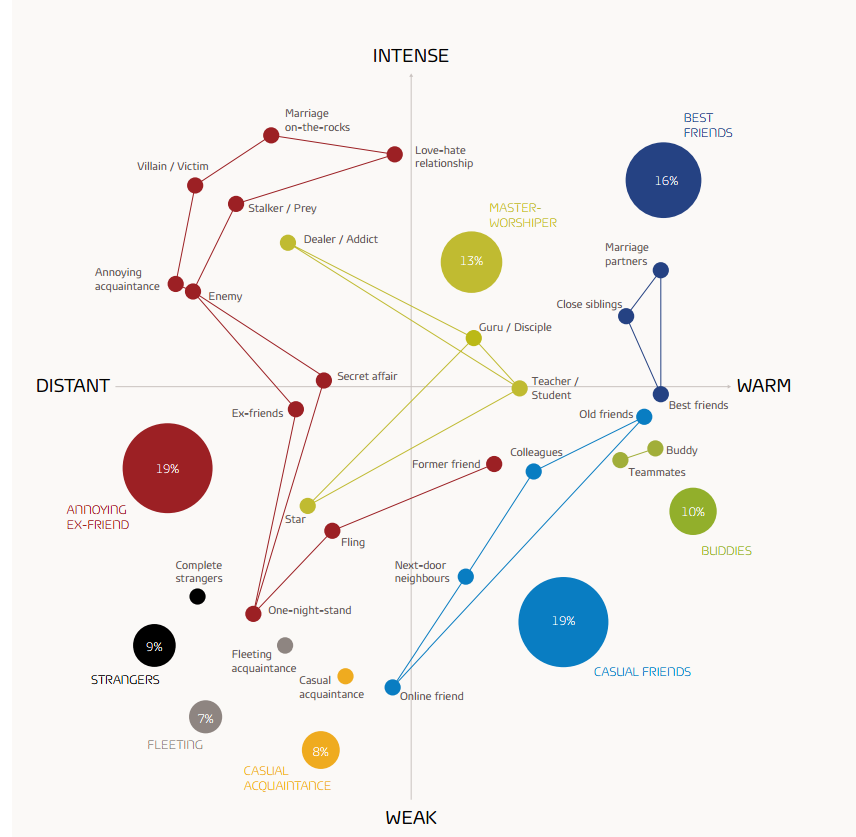
Brand relationships come in all shapes and sizes, but marketers tend to focus on loyal brand “marriages,” missing opportunities to relate to customers who may see their brand as a best friend, a fling, or even an adversary, says Boston University’s Susan Fournier.
At MSI’s February 2014 conference, “Brands in the Balance: Managing Continuity and Change,” Fournier and John Wittenbraker of GfK discussed how managers can overcome such myopia and build stronger customer-brand relationships.
While many managers embrace the idea of relationship marketing, the practice of customer relationship management has devolved to customer profitability management, she points out. “A lot of relationship marketing is IT-led and IT-enabled and while these professionals know how to manage data they do not necessarily understand relationships. Bribing with cash incentives, locking-in, giving a membership card. Is that a relationship?”
Firms need to refocus on managing the relationship equity in their total portfolio of brand relationships, Fournier says. They will find that their consumer—brand relationships are complex and multi-dimensional. Some may be functionally-oriented, some superficial and fleeting, and some emotional and social. Each type of relationship has different norms and expectations. “If you learned your brand was a ‘secret affair’ for a sizable segment, for example, as we learned with Cheetos, ‘Sex in the City,’ Wal-mart, and National Enquirer, you are going to think twice about your advertising messages and marketing campaigns. A fashion brand marketed as a ‘best friend’ versus a ‘fling’ brand is going to have a different brand story, identity, and feel.”
Fournier cautions marketers not to forget about managing negative relationships, which her research shows comprise on average 45% of consumers’ relationships with brands. “If a customer of the New York Philharmonic feels they are in a stalker-prey relationship, you better develop a plan to manage that. And you might think twice about sending Development after them for donations, which is the knee-jerk reaction of CRM.”
“There is profit potential in all types of relationships,” says Fournier. “The trick is to understand the specific relationship contract and the implicit rules that govern consumers’ brand interactions.”
While managers claim credit for profitable relationships, they rarely look inward to learn why some relationships go bad. For example, companies often reward good customers with discounts and special treatment and permit them to break rules. These “best customers” become costly to serve and may even eventually be “fired” by the firm. “Firms need to pay attention to their signals. All signals. Not just the ones in the marketing plan.”
“There is profit potential in all types of relationships,” says Fournier. “The trick is to understand the specific relationship contract and the implicit rules that govern consumers’ brand interactions. You have to play by the rules.”
Rather than seeking simply to maximize revenue in a journey to gold customer status, firms should segment their customers by relationship type, Fournier suggests. With this portfolio map, they can determine which segments to target, and develop strategies by reverse-engineering best and worst relationships.
“You can know a purchaser by collecting purchase and demographic data, but to establish a relationship you really need to understand what makes the person tick,” Fournier says. “As marketers, we tend to think it’s all about the brand—no, it’s all about people’s lives and if you are lucky, your brand will come into those lives.”

Click to access BaCE-How-Deep-is-your-love.pdf
Click to access Putting%20the%20R%20Back%20into%20CRM_Sloan%20Management%20Review_April%202011.pdf
http://www.msi.org/articles/5-things-i-know-about-marketing/
This link contains great articles to read; very informative.
As brand managers and branding researchers, we put brands at the center of our thoughts and activities and in doing that, we lose perspective. We have supermarkets brimming with 60,000 SKUs and literally thousands of brands. Every brand manager thinks that their brand plays or could play a big role in people’s lives. That is not—and simply cannot be—the case!
People are social animals; at their core they are all about relationships with others. Our families, our friends, our coworkers—that’s what drives us. Brands sometimes play a role in that, but no matter how you slice it, they are the means in people’s lives, not the ends.
Brands can be a means to get the kitchen cleaned, which is just something I do as a mother with an Italian heritage, or they can be a means to express a certain vision of myself, an identity that matters to me, or a role I want to perform well. The key word is “can”.
Very often, brands are totally in the background. Maybe John likes to bike, and he is part of a biking club and he goes out every Saturday and participates in races. For him, it’s about the community of bikers. The bike is there; he enjoys it, but the point of this brand relationship is the people that he is riding with. His Cannondale is a means to that end.
To advance brand strategy, marketers will typically do a category study—map the attributes and benefits of, say, Minute Maid versus Tropicana versus Simply Orange—and act as if this brand-defined context is what the world is all about. Well guess what? It’s about the people, not the brands. If we want strong brands we have to start with a deep understanding of the people and figure out where our brands fit into their lives, if at all.
We take a really shallow view of customer development. Brand managers try to move people in aggregate groups along one path, typically from shallow to deeper. Did you buy more? Are you with us longer? Do you advocate for the brand among your friends? But there is a lot more going on than progressive layers of loyalty and commitment.
Ironically, big data can thwart the mission to develop more inspired customer development plans. The analyst’s job is to reduce everything to 0’s and 1’s. To take out context that can complicate things. To reduce the data to empirical relationships with correlations like, “People in zip code X tend to buy peanut butter sandwiches.” But this is information without meaning. We are overly enamored of information when we need to be focused on meaning. This complicates things, but no one said it would be easy.
Everything we do affects the brand meaning and hence the brand relationship, whether it is in the brand strategy or not. Marketers might send out coupons or a survey; their intent is clear—to ignite purchase—but this is a meaning-laden signal and people may interpret this signal in completely different ways. For one person the coupon says, “You really don’t care about the important things in this relationship”; for another it validates the tit-for-tat nature of a basic exchange.
Brands and the organizations that represent them leak signals constantly. When Martha Stewart told Barbara Walters that her alleged illegal sale of ImClone stock was meaningless, insignificant, and represented a mere fraction of a percent of her personal financial equity, she created brand meanings that certainly did not help her brand. Unintended signals can stand as big statements about what the organization believes in or doesn’t believe in, and fundamentally affect the brand at its core.
Marketers do tons of work to figure out a brand’s positioning and they spend millions of dollars communicating and reinforcing that. To make things tractable, they want to circumscribe brand meaning and put it in a box: “This brand is the [blank] among all [blanks] because it [blanks].” But when a brand gets into a person’s life, there isn’t consensus about what it means. Multivocality and co-creation are terms that have been used: a brand speaks with many voices.
My doctoral student Claudio Alvarez has shown empirically that brands have less shared meaning than they have idiosyncratic or personalized meaning. Yet, our entire branding philosophy is founded on the task of finding one differentiated meaning and repeating it until everyone develops shared knowledge and familiarity with that positioning. Things would change radically if the paradigm was refocused to encourage idiosyncratic meaning.
Basic exchange relationships are the most prevalent form of relationality in the commercial space. Yet we are always trying to move beyond them. I think there is a lot to appreciate in basic exchanges, especially because habits are often involved. Habits run deep and our understanding of them is shallow.
Or consider brand flings, which we also dismiss: “Oh, that’s bad, the consumer played with us and then they moved on.” No, that’s awesome. A fling has tremendous passion and an amazing amount of investment. You’re obsessed; it’s all-consuming. Yet we always want to move people out of flings into brands marriages.
Just think about a situation where 100,000 people are having a fling with your brand this year and another 100,000 people are having a fling next year. You can run a whole business on that! Get more people to have flings and then maybe have a product portfolio so they can go to another brand and have another fling when the passion dwindles. Embrace it—it’s beautiful stuff!
Marketers also tend to ignore the negative relationships that likely populate their brand relationship portfolios. In cross-cultural research with GfK, we learned that on average 45% of a brand’s relationships are negative. Yes, we have some insight into managing service failures, but that does not constitute a science of negative relationships. Abusive marriages, enemies, ex-friends, addictions, stalker-prey. These are the relationships that can make or break you. Do we know how to manage them? To think you can turn these into brand marriages is optimistic at best. These relationships each need to be dealt with on their own terms. What are the rules of these relationships? What meanings are being sought and delivered in the brand? Those are questions we could be asking. You can create interesting segments with that data and craft strategies to migrate people across relationships in your brand’s relationship space.
In marketing we are revenue-centric; we don’t think a lot about risk. But risk is a huge part of branding. People stick with a brand to control risk: psychological risk, financial risk, the risk of failure. In stewarding a brand, the manager’s job is to understand risk and manage accordingly.
In a project with my BU colleague Shuba Srinivasan, we analyzed ten years of data on brand architecture strategies—for example, Fed-Ex and its “Branded House” where everything is branded Fed-Ex, or Apple’s sub-branding strategy with the Apple iPod, or endorsed branding as with Courtyard by Marriott, where two brands are combined and the secondary brand is prominent. We learned that some of these strategies are inherently riskier than others: there’s risk of meaning dilution, risk of reputation loss in the wake of failures, cannibalization risk, and financial risk from lost opportunities or competition for management time. When you factor in risk, the standing recommendations for certain strategies change. Sub-branding, most notably, exacerbates rather than controls risk.
“Person branding” is another interesting scenario where managing risk—the risk of personal crisis, the risk of death—is more elemental than managing revenues and returns. Think of Taylor Swift, Martha Stewart, Tiger Woods, and even Barack Obama.
We could rethink the entire exercise of branding as risk management. It reframes everything. Do we have the skill sets and conceptual frameworks to migrate to risk management? I do not think so.
Qualitative research has a long history in marketing. Ernest Dichter, one of the early pioneers in consumer psychoanalytic research, first applied these research principles in a study for Plymouth automobiles in the 1930s. Some of his assertions were fairly controversial. For instance, he equated convertibles with youth, freedom, and the secret wish for mistresses; argued that women used Ivory soap to wash away their sins before a date; and maintained that baking was an expression of femininity and pulling a cake or loaf out of an oven for women was “in a sense like giving birth.” His suggested tagline “Putting a Tiger in the Tank” for Exxon resulting in a long-running and successful ad campaign, however.
(Keller 2013:327) For personal record purpose only.
What is Mantra?
A word or sound which is believed to possess a special spiritual power, especially in Hinduism and Buddhism.

Brand Mantra examples:
1. Nike: Authentic Athletic Performance
2. Disney: Fun Family Entertainment
3. Ritz-Carlton: Ladies & Gentlemen Serving Ladies & Gentlemen
4. BMW: Ultimate Driving Machine
http://newkind.com/2011/10/13/kevin-kellers-five-favorite-classic-brand-mantras/
Brand Mantra vs. Tagline/slogan
http://darkmattermatters.com/2010/03/17/brand-positioning-tip-9-a-brand-mantra-is-not-a-tagline/

激烈的市场竞争引发了大量的抄袭模仿行为,技术创新只能带来短暂的领先优势,其后就马上堕入同质化的海洋。怎样创造出与竞争对手不同的差异化特色,已成为摆在营销者面前的一大难题。差异化的实质就是给顾客一个购买理由,即为什么买你的而不买别人的。这就要求企业努力聚焦,把一件事做到极致,凭借别人无法企及的某种特色来赢得客户。
总结起来,要提炼产品的卖点,实施差异化定位可以从以下途径入手:
其一,在原料方面差异化
依云矿泉水是世界上最昂贵的矿泉水,传说每滴依云矿泉水都来自于阿尔卑斯山头的千年积雪,然后经过15年缓慢渗透,由天然过滤和冰川砂层的矿化而最终形成。大自然赋予的绝世脱俗的尊贵,加之成功治愈患病侯爵的传奇故事,依云水成为纯净、生命和典雅的象征,以10倍于普通瓶装水的奢侈价格来销售。
哈根达斯宣传自己的冰激凌原料取自世界各地的顶级产品,比如来自马达加斯加的香草代表着无尽的思念和爱慕,比利时纯正香浓的巧克力象征热恋中的甜蜜和力量,波兰的红色草莓代表着嫉妒与考验,来自巴西的咖啡则是幽默与宠爱的化身,而且这些都是100%的天然原料。“爱我,就请我吃哈根达斯”,自1996年进入中国,哈根达斯的这句经典广告语席卷各大城市。一时之间,哈根达斯成了城市小资们的时尚食品。而看看哈根达斯的定价,就该让工薪阶层咋舌了,最便宜的一小桶也要30多元,贵一点的冰淇淋蛋糕要400多元。
国内企业方面,养生堂买断了浙江千岛湖20年的独家开发权之后,发动了针对纯净水的舆论战。广告词“农夫山泉有点甜”带有明显的心理暗示意味,为什么甜?因为是天然矿泉水,因为含有多种微量元素,所以在味道上不同于其他水。又如蒙牛、伊利很多广告将来自大草原的优质奶源作为卖点。
其二,在设计方面差异化
苹果公司的产品一向以设计见长,随着imac台式电脑、ipod音乐播放器、iphone手机、ipad上网本,一个个让人耳目一新的产品冲击着用户的心理防线,将苹果品牌变身为时尚与品位的先锋。
Swatch手表创新性地定位于时装表,以充满青春活力的城市年轻人为目标市场。以“你的第二块手表”为广告诉求,强调它可以作为配饰搭配不同服装,可以不断换新而在潮流变迁中永不过时。Swatch的设计非常讲究创意,以新奇、有趣、时尚、前卫的一贯风格,赢得“潮流先锋”的美誉。而且不断推出新款,并为每一款手表赋予别出心裁的名字,5个月后就停产。这样个性化的色彩更浓,市场反应更加热烈,甚至有博物馆开始收藏,有拍卖行对某些短缺版进行拍卖。
其三,在制作工艺方面差异化
真功夫快餐挖掘传统烹饪的精髓,利用高科技手段研制出“电脑程控蒸汽柜”,自此决定将“蒸”的烹饪方法发扬光大。为了形成与美式快餐完全不同的品牌定位,真功夫打出了“坚决不做油炸食品”的大旗,一举击中洋快餐的“烤、炸”工艺对健康不利的软肋。
在环境危机日益加重、人们健康意识不断提升的情况下,乐百氏纯净水“27层净化”的传播口号,能给焦虑的人们带来稍许安全感。
其四,在渠道方面差异化
戴尔电脑的网络直销消除了中间商,减少了传统分销花费的成本和时间,库存周转与市场反应速度大幅提高,而且能够最清晰地了解客户需求,并以富有竞争性的价位,定制并提供具有丰富选择性的电脑相关产品。想订购的顾客直接在网上查询信息,5分钟之后收到订单确认,不超过36小时,电脑从生产线装上载货卡车,通过快递网络送往顾客指定的地点。由于互联网技术的日益普及,利用网络渠道营销的企业越来越多,比如携程旅行、凡客诚品服饰和淘宝等。
安利和雅芳的人员直销,与走大卖场、专柜路线的化妆品和保健品形成了差异化。当然这种差异化是否对顾客创造了额外的价值,则仁者见仁,智者见智。
其五,在功能方面差异化
顾客选购商品是希望具有所期望的某种功效,如洗发水中飘柔的承诺是“柔顺”,海飞丝是“去头屑”,潘婷是“健康亮泽”,舒肤佳强调“有效去除细菌”,沃尔沃汽车定位于“安全”等就是基于这一策略,只要在顾客需求的某方面占据顾客心智中的第一位置,就有机会在竞争中胜出。
王老吉原本是区域性的中药凉茶,在香港加多宝的运作之下,淡化其成分,凸显其功能,从而创造出一个新品类–预防上火的饮料!“上火”是人们可以真实感知的一种亚健康状态,“降火”的市场需求日益庞大。而凉茶的“预防上火”和“降火”功效,是与其他饮料相比的核心优势,因此重新定位之后的王老吉畅销全国。
养生堂的“朵尔”是专门针对女性细分市场,紧扣女性对美丽的渴望,在概念营造上棋高一招,提出“由内而外地美丽”.言外之意就是别人都在做表面功夫,而“朵尔”可以内外兼修,立即就会打动顾客的心。还有比如红牛的补充能量定位,脑白金的礼品定位等,都是直接从用途上与竞争对手差异化。
其六,在服务方面差异化
迪斯尼公司认为首先应该让员工心情舒畅,然后他们才能为顾客提供优质服务,首先让员工们快乐,才能将快乐感染给所接待的顾客。别忘了人们来到迪斯尼就是为了寻找欢乐,如果服务不满意,扫兴而归,那还会有什么人再来呢?因此公司注重培训和员工福利,重视构建团队及伙伴关系,以此提高服务水准。
海底捞火锅连锁店为劳动密集型企业尊重和激励员工做出了表率,管理层认为:客人的需求五花八门,仅仅用流程和制度培训出来的服务员最多只能及格。因此提升服务水准的关键不是培训,而是创造让员工愿意留下的工作环境。和谐友爱的企业文化让员工有了归属感,从而变被动工作为主动工作,变“要我干”为“我要干”,让每个顾客从进门到离开都能够真切体会到其“五星”级的细节服务。这些付出也为海底捞带来丰厚的回报,旗下30多家连锁店,一直稳稳占据着所在城市“服务最佳”的榜首位置。
其七,形象方面差异化
形象因素与设计和制作工艺有一定联系,但也可以独立出现。万宝路让同质化的香烟与众不同,秘诀就在于为品牌注入了豪迈阳刚的牛仔形象。赋予品牌某种精神和形象,可以满足顾客的某些精神需求,这种精神沟通以实体商品为基点,又脱离于商品实体之外,为顾客创造了附加的心理价值,可以建立与顾客之间更加牢固、更加密切的情感联系。
哈雷·戴维森摩托在两次世界大战中成为美国军用摩托,所以成为退伍老兵的最爱,那张扬的外形、轰鸣的声音代表了一种激情、冒险、挑战传统的精神,最终这种品牌主张向社会扩散,许多青年人也借哈雷来表达自己自由、梦想、激情、爱国等种种情感。而哈雷摩托车的售价大多超过两万美元,贵过普通的轿车,虽然如此成千上万的哈雷迷们依旧是无怨无悔。
其八,营销手段差异化
新媒体层出不穷,单纯投放电视、报纸杂志等传统媒体,一招打遍天下的时代已经过去,社会化媒体、社交媒体已经成了新品牌营销的主要战场。小米手机在初期仅仅在框架媒体上投放硬广,用极具性价比的手机配置吸引到目标用户关注后,便积极的运用论坛和微博等社交媒体发起一轮轮的讨论热潮,不到两年,就成了国产手机中的佼佼者。
从楼宇电视、框架这类社会化媒体引发话题,引爆社交媒体讨论;或在社交媒体上发起话题,而在社会化媒体上将用户需求落地的营销案例还有很多,褚时健的褚橙在去年火了一把,其背后的本来生活网是最大赢家;而抢票神器猎豹浏览器挑战铁道部的一系列楼宇广告也让其赚足了眼球,今年猎豹已在筹备上市。
综上所述,产品的差异化可以从8个方面入手,如果上述做法都行不通,要打动顾客购买,就只有降价一条路了。当然降价时,你如果拥有超越竞争对手的成本控制能力,也还是会取得利润。如果成本上也没有优势,那只能遗憾地宣布你已经堕入了红海,运气好时可以获得些许利润,一有风吹草动就会陷入亏损境地。
要想差异化定位成功,仅仅选择了差异化因素是不够的,还必须检讨差异化的因素能不能为顾客,特别是目标顾客创造价值,从而成为吸引其购买的卖点。另外需要检查在顾客心目中你的产品已经具备预设的差异化卖点,大部分顾客不是专业人士,他们决策时理性夹杂着感性,如果他们认为你在差异化因素方面并不突出时,这样就必须开动脑筋,利用大胆出位的传播方案将自己的优势打出来。
(如有知识产权争议,请联系本人,来源:创业邦)
KFC-fried rats PR crisis in the 70s. But the brand survived and is doing great right now.
Black Belt vs. Ozone
Should Vibhava kill Black Belt?
——————————————————————————————————————————————————————
Some notes:
GE revived, Apple revived, dramatically, and some other brands survived as well.
So what’s the math to do when a company is considering about whether to kill/eliminate a brand ?
“You gotta be very careful when you are trying to kill a cash cow, even if it’s dying”.
 Tianfeng Sun --- Sky, Breeze, and Sun --- Freedom.